Sharding
Sharding (also called partitioning) is the process of splitting arrays across multiple accelerators to enable distributed computation for models that exceed the memory capacity of a single device.
Key Concepts
Shapes of Sharded Arrays
- Global/Logical Shape: The conceptual size of the complete array
- Device Local Shape: The actual size stored on each individual device
- Memory Reduction: Each device typically stores only 1/N of the total array (where N is the number of shards)
Device Mesh
A device mesh is a multi-dimensional grid of accelerators with assigned axis names:
- Typically 2D or 3D arrangement (X, Y, Z axes)
- The mesh defines the physical layout of the devices
- Example:
Mesh(devices=((0, 1), (2, 3)), axis_names=('X', 'Y'))
Named-Axis Notation
We use subscript notation to indicate how array dimensions are distributed:
- A[I, J]: Fully replicated array (complete copy on each device)
- A[IX, J]: First dimension sharded along X mesh axis
- A[IX, JY]: First dimension sharded along X, second along Y
- A[IXY, J]: First dimension sharded along both X and Y (flattened)
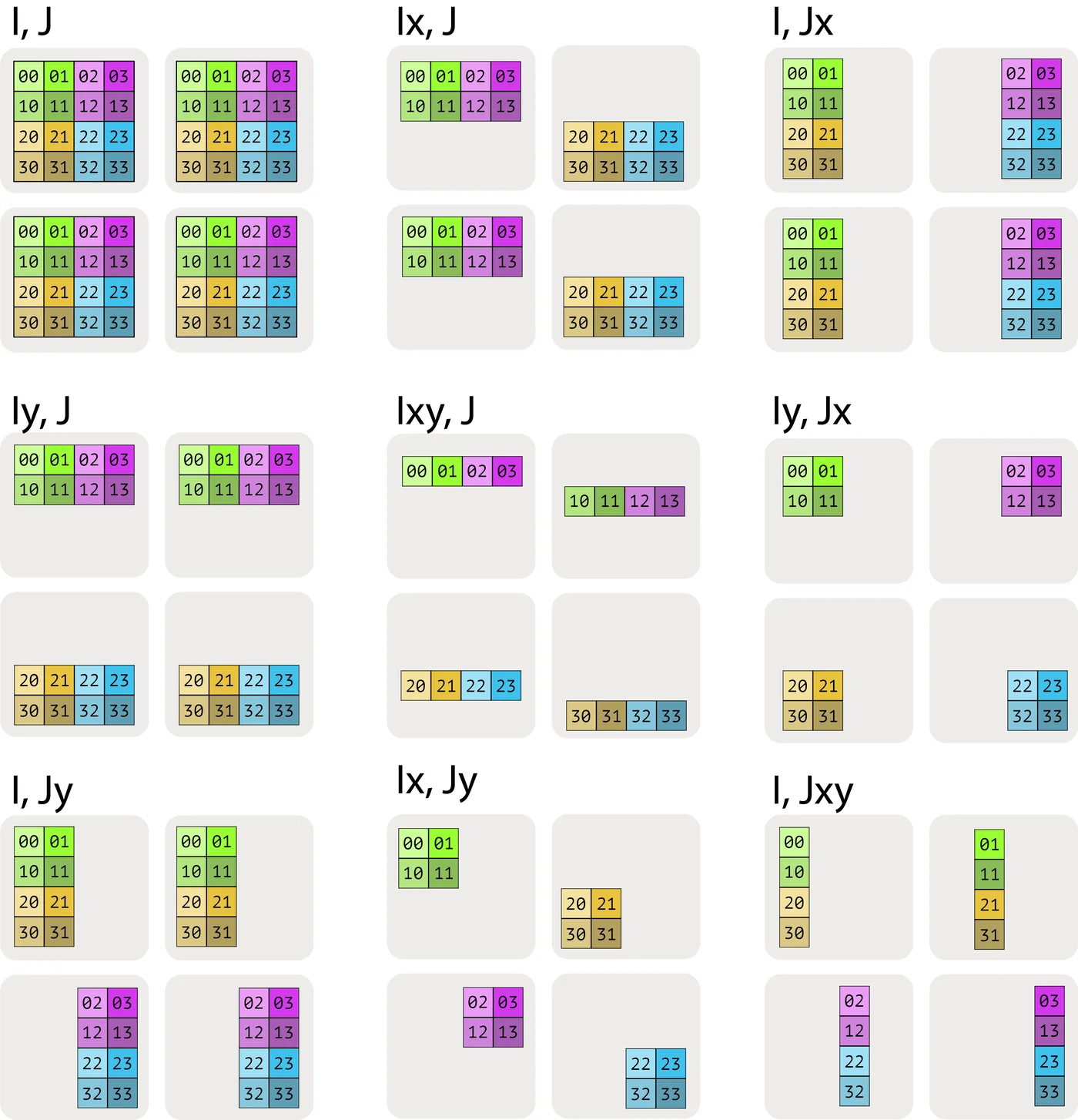 Figure: Different sharding patterns visualized
Source: How to Scale Your Model
Rules and Constraints
- Unique Mesh Axis Assignment: A mesh axis can only be used once in a sharding (e.g., A[IX, JX] is invalid)
- Local Shape Calculation: For dimension I sharded across X: local_size = ⌈global_size / |X|⌉
- Memory Usage: Total memory across devices = global_size × replication_factor
Implementation in JAX
# Create a 2D mesh of 8 devices in a 4x2 grid
mesh = jax.make_mesh(axis_shapes=(4, 2), axis_names=('X', 'Y'))

# Define sharding specification
sharding = shd.NamedSharding(mesh, shd.PartitionSpec('X', 'Y'))

# Create a sharded array
A = jnp.ones((8192, 4096), dtype=jnp.bfloat16, device=sharding)
Benefits of Sharding
- Memory Efficiency: Enables working with arrays larger than a single device’s memory
- Computation Parallelism: Each device computes on a subset of the data
- Communication Reduction: Proper sharding can minimize data transfer between devices
Sharding Strategies
Different parallelism strategies use sharding in specific ways:
- Data Parallelism: Shard batch dimension (A[BX, …])
- Tensor Parallelism: Shard model dimensions (A[…, DX] or A[…, DX, FY])
- Zero-1/2/3: Shard optimizer states, gradients, and/or parameters
- Expert Parallelism: Shard expert dimension in Mixture of Experts models